

Golf rules for mown grass
We've all been there: you're playing a relaxed round of golf - and next to the fairway or in the rough is a freshly mown row of grass or even a thick pile of clippings. Greenkeeping or the farmer has been busy - but what does this mean for your game in terms of the rules?
IIn this article, we clarify what applies according to the Rules of Golf - depending on whether the grass is standing up, lying loose or has been gathered in rows.
Tall grasses at the edge of the fairway, in the semi-rough or rough are a normal part of the course. Even if they make the game more difficult or appear “unkempt”, they are not considered abnormal course conditions.
→ You must play the ball as it lies or declare it unplayable (Rule 19), which entails a penalty stroke.
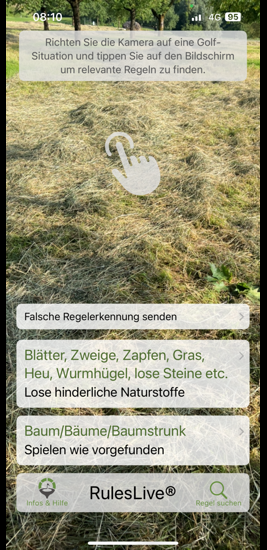
Freshly cut grass lying singly or loose on the ground is a loose impediment (Rule 15.1).
→ You may remove it without penalty as long as the ball does not move.
If the ball moves, you must replace it - this costs a penalty stroke.
When mowing by greenkeeping or farmers, rows of grass often form - i.e. longish deposits of clippings along the course or at the edge.
Not every row of grass on the course is a “ground under repair” (GUR)! It depends on the purpose and condition:
- Fresh rows of grass, such as those created directly during mowing, are not considered abnormal course conditions. They are part of the General Area and count as loose impediments.
→ You may remove the grass, but you may not drop it without penalty.
- Dried rows of grass that are clearly intended for removal - for example by greenkeeping or a farmer - may count as ground under repair (GUR).
→ In this case, you may make use of penalty-free relief in accordance with Rule 16.1b (dropping).
- it has been prepared for removal,
- it has been marked or declared as GUR by the course manager,
- or whether this is stipulated by local rules.
→ If your ball lies in it, you can take free relief
→ If your ball is off the mark but your stance or swing is impeded, you are also entitled to free relief if the area is considered a GUR.
5. Three situations in detail
a) Ball lies in a row of grass or a heap that is GUR
→ You may drop without penalty - to the nearest point of complete relief (not closer to the hole, within one club length).
b) Ball cannot be found - but presumably lost in the GUR grass row
→ If it is “known or almost certain” that the ball was lost in the GUR, you may also drop without penalty - at the suspected location in the GUR.
c) Ball lies outside, but stance or swing are impeded
→ Even then, you can drop without penalty if the obstruction is GUR.
5. Conclusion - look carefully!
Whether tall grass, freshly mown rows or piled hay - the rules of golf make clear distinctions.
Only if the grass is dried, clearly intended for removal and possibly marked as GUR by the course manager may you claim free relief.